
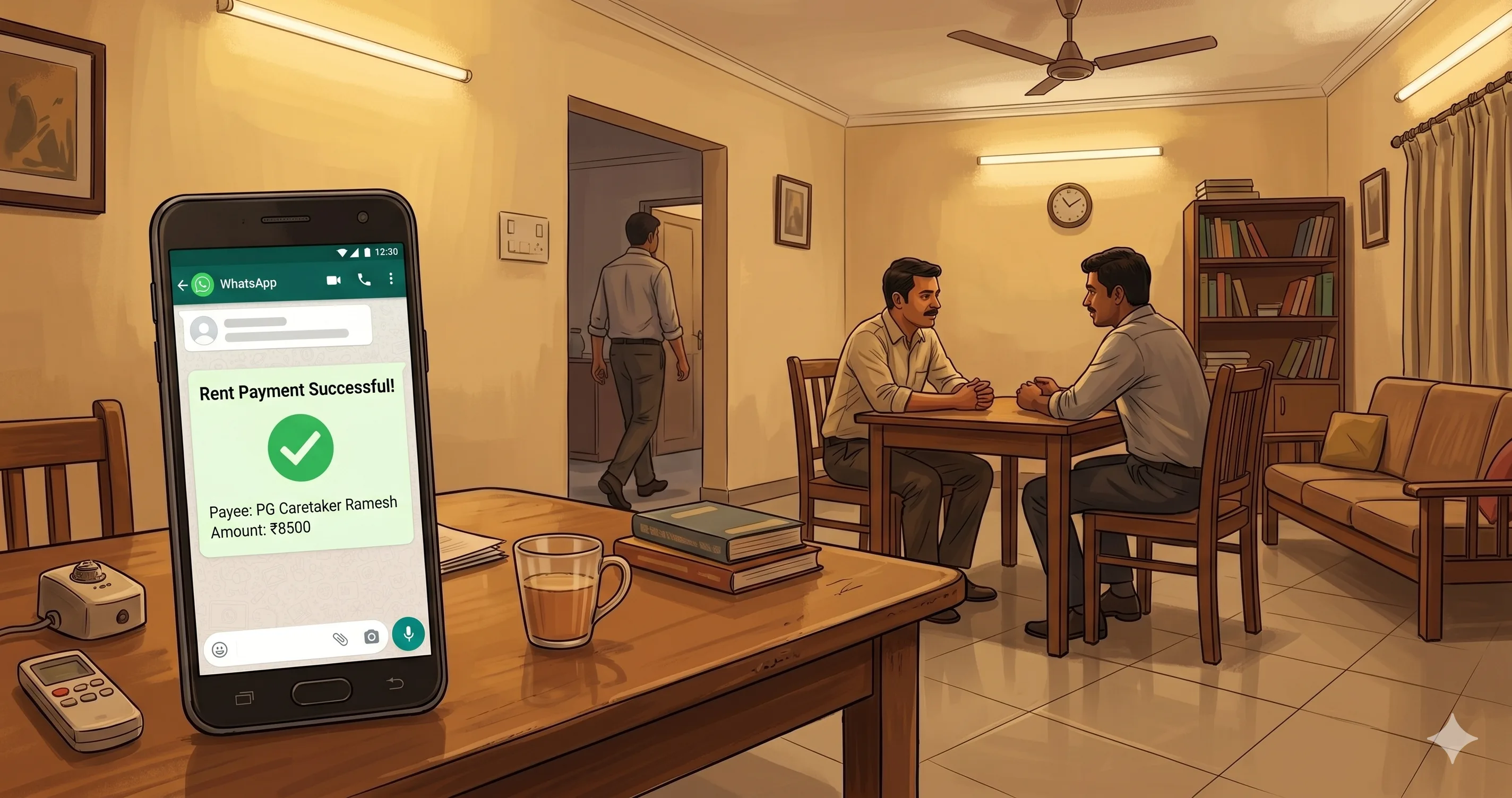
You have 60 occupants. Rent is due on the 1st. By the 5th, maybe 35 have paid. You know this because you've been scrolling through your UPI transaction history, cross-referencing it against a WhatsApp group and a notebook. Three people joined mid-month, so their amounts are different. One person's deposit is still pending from two months ago. And someone just messaged asking for a receipt.
This is the daily reality for most PG hostel operators in India. It's not a technology problem. It's a time problem, a tracking problem, and — if you're honest — a mental load problem.
This guide covers everything you need to manage fee collection for your PG properly: the real friction points, how pro-rata billing works, the GST question nobody talks about openly, how to track security deposits, and what software options actually make sense for a solo operator running 20 to 150 beds.
Why Manual Rent Collection Breaks Down After 30 Occupants
Below 20 occupants, WhatsApp and a notebook work. You know everyone by name. You remember who's late. You can hold it in your head.
Past 30, it stops working. Not because you're disorganized — because the volume of micro-decisions compounds. Did Rahul pay for May or June? Was that 7,500 or 8,000 because he moved to an AC room? Did you return Priya's deposit when she left, or is that still outstanding?
The problem isn't that you're chasing fees manually. The problem is that manual chasing doesn't leave a record. Every WhatsApp message is a one-off. Every UPI transfer looks identical in your bank statement. Nothing connects.
Most PG operators in Hyderabad's IT corridors — Gachibowli, Madhapur, Kondapur — manage working professionals who pay digitally and expect receipts. These occupants aren't difficult. They just need a clean way to pay and confirmation that it registered.
When you can't give them that, the problem isn't collections. It's credibility.
The Pro-Rata Problem No One Solves Well
Mid-month joiners are the most common source of billing confusion in PG hostels.
Someone moves in on the 14th. Your rent cycle runs from the 1st to the 30th. What do you charge? Most operators calculate it manually — divide the monthly rent by 30, multiply by the remaining days — then message the amount over WhatsApp. The occupant pays what they think is right. You hope it matches.
It rarely does. And then the following month, you have to remember that this person's regular billing starts from the 1st, while their first payment covered only a partial period.
This is where spreadsheets start multiplying. One sheet for current occupants, one for partial-month joiners, one for people who've left but whose deposits aren't settled. By the time you have 50 occupants with varying move-in dates, the spreadsheet is a liability, not an asset.
A proper fee collection system for PG hostels should handle pro-rata billing automatically — calculate the first-month amount based on move-in date, then switch to the standard cycle from the next month. That's the baseline. If a tool doesn't do this, it's not built for PG operations.
Security Deposits: The Invisible Liability on Your Books
Security deposits are the most under-tracked item in PG management.
You collect two months' rent upfront. You don't put it in a separate account. You spend it. Then, eight months later, when an occupant vacates, they ask for it back. You have to figure out whether there are deductions, how much is left, and when you can return it.
Without a record, that conversation gets uncomfortable fast. The occupant remembers paying ₹15,000. You remember there was a deduction for a broken fixture. Neither of you has documentation.
Good deposit tracking means recording the amount collected, the date, any deductions with reasons, and the refund date. It sounds simple. Almost no PG operator does it consistently, because there's no easy place to record it that also connects to the rest of your billing.
This is worth solving properly. Deposit disputes are one of the most common reasons PG operators get negative reviews — and in cities like Hyderabad, where the working-professional market runs on word of mouth and referrals, one bad review sticks.
The GST Question: Cash vs. UPI and What It Actually Means
Here's the conversation that doesn't happen openly enough.
Many PG operators prefer cash or informal UPI transfers specifically to stay below the GST registration threshold. If your annual rental income crosses ₹20 lakhs, you're technically required to register for GST. For a 60-bed PG charging ₹8,000 per bed, that's ₹57.6 lakhs annually — well above the threshold.
Some operators handle this by keeping transactions informal, splitting income across family members, or simply not issuing formal receipts. This is a real business decision, not a moral failing. The tax structure around PG accommodation in India is genuinely complex, and the compliance burden for a solo operator is not trivial.
That said, the trend is shifting. The IT workforce in Hyderabad increasingly works for companies that require rent receipts for HRA exemptions. If your occupants can't get a proper receipt, they'll move to a PG that provides one. You lose good, reliable tenants to competitors who've figured out the paperwork.
The practical answer for most operators: get proper advice from a CA on your specific situation, then build your billing system around whatever structure you land on. Don't let the GST question be a reason to avoid having any system at all. A good fee collection tool should let you issue receipts when you need to and skip them when you don't — without forcing you into a compliance framework you're not ready for.
What to Look for in Fee Collection Software for PG Hostels
Most software built for property management is overkill for a PG operator. You don't need a full property management ERP. You don't need maintenance ticketing, lease management, or a tenant portal with a login.
What you actually need is specific:
Automated WhatsApp reminders that go out before and after the due date, without you having to type them
UPI payment links that occupants can pay from directly, without downloading an app
Pro-rata billing that handles mid-month joiners without manual calculation
Security deposit tracking that shows you what's collected, what's outstanding, and what's been refunded
A dashboard that gives you the full picture — who's paid, who hasn't, and how much is overdue — without opening a spreadsheet
Receipt generation that works when you need it
That's the list. If a tool does all six well, it's a good fit. If it does three of them but requires you to also learn a full LMS or property management system to access them, it's not built for you.
RentOk vs. Zapstel vs. Roomindo vs. Feezy: Which One Fits a PG Operator?
Here's an honest comparison of the main options in the Indian market as of 2026.
Criteria | RentOk | Zapstel | Roomindo | Feezy |
|---|---|---|---|---|
Built for | Residential landlords, PGs | PG hostels, co-living | PG hostels, student housing | Coaching institutes, PGs, gyms, studios |
WhatsApp-native payments | Partial | No | No | Yes — payment link via WhatsApp |
Pro-rata billing | Manual entry | Yes | Yes | Yes — automated on move-in date |
Security deposit tracking | Basic | Yes | Yes | Yes |
App download required for occupants | No | Yes (tenant app) | Yes (tenant app) | No — pays via WhatsApp link |
Receipt generation | Yes | Yes | Yes | Yes |
Pricing model | Subscription | Subscription | Subscription | Subscription |
Best for | Landlords with multiple properties | Larger PGs and co-living operators | Student hostels, managed PGs | Solo PG operators, 20–150 beds |
RentOk works well if you're a landlord managing multiple individual rental units. For a PG with 40–60 beds and a shared billing cycle, it's a reasonable option — just not purpose-built for the PG model.
Zapstel is more feature-complete for PG operations. It has occupancy tracking, maintenance requests, and tenant management. If you're running a 100+ bed co-living operation with staff, it's worth evaluating. For a solo operator, it's more system than you need.
Roomindo focuses on student housing and managed PGs. The tenant-facing app is polished, but it requires your occupants to download and use it. In practice, working professionals in Gachibowli don't want another app. They want to pay via UPI and move on.
Feezy takes a different approach. It's built around the idea that the occupant should be able to pay with zero friction — no app, no login, just a WhatsApp message with a UPI link. For the solo PG operator who wants automated reminders, clean tracking, and receipts without running a full property management system, that's a meaningful difference.
You can see how Feezy handles PG billing specifically at feezy.one/solutions/pg-hostel.
How Automated WhatsApp Reminders Actually Work in Practice
The friction in manual fee collection isn't the collection itself. It's the reminder loop.
You send a WhatsApp message. The occupant reads it and forgets. You send another one three days later, slightly more pointed. They feel awkward. You feel awkward. They pay eventually, but the relationship has a small dent in it.
Automated reminders change this dynamic because they're not personal. The message comes from the system, not from you. Occupants don't feel chased — they feel informed. And because the reminder includes a direct UPI payment link, paying takes 30 seconds.
Feezy sends WhatsApp reminders automatically before the due date, on the due date, and after — on a schedule you set once. When the occupant pays, Feezy marks the payment, sends a receipt, and updates your dashboard. You don't do anything. You just check the dashboard to see where things stand.
That's the full picture without a spreadsheet.
Setting Up Fee Cycles for a PG: What to Decide Before You Start
Before you configure any system, you need to make three decisions about your billing structure.
1. When does your rent cycle start?
Most PGs bill from the 1st of the month. Some bill from the occupant's move-in date — a rolling cycle. The 1st-of-month approach is simpler to track. Rolling cycles are fairer for occupants but harder to manage manually.
2. How do you handle advance rent?
Many PGs collect one or two months' advance. Decide whether this is a security deposit, advance rent, or both — and track it separately from monthly billing.
3. What are your add-on charges?
Electricity, food, laundry, parking — if these vary by occupant, you need a system that handles variable charges on top of base rent. Make sure whatever tool you choose supports this before you commit.
Getting these three things clear before you set up your software saves you from having to rebuild your configuration later.
Feezy's pricing page at feezy.one/pricing covers what's included at each tier if you want to check whether it fits your setup.
What Occupants Actually Want from Their PG's Billing System
Working professionals in Hyderabad's IT belt are not difficult to collect from. They earn well, they pay digitally, and they're used to clean UPI transactions.
What they want is simple: a clear amount, a frictionless way to pay it, and a receipt they can use for HRA claims. That's the entire requirement.
When your billing system delivers that, collections improve — not because you're chasing harder, but because paying is easy. The occupant gets a WhatsApp message, taps the link, pays via UPI, and gets a receipt in the same thread. Done.
When your system doesn't deliver that, you get delays, confusion, and the occasional dispute. Not because the occupant is difficult, but because the process is.
A Note on Data Security and Trust
When you collect payments digitally and store occupant data, you take on a real responsibility. Occupants are sharing payment information and personal details with your system. That matters.
Before choosing any fee collection tool, check how it handles data. Is payment processing handled by a licensed payment gateway? Is occupant data stored securely? Feezy's approach to this is covered at feezy.one/security if you want to review it before committing.
This isn't a minor concern. It's the kind of thing that builds or erodes trust with the working-professional market you're serving.
The Honest Case for Automating Your PG's Fee Collection
Manual collection works until it doesn't. Most PG operators know they need a better system. The reason they haven't moved is usually one of three things: setup feels like too much work, the cost seems unclear, or they're not sure occupants will actually use it.
Setup for a 50-bed PG on Feezy takes a few hours. You add your occupants, set your rent amounts and billing dates, and the reminder engine takes over. The cost is a flat monthly subscription — not a percentage of collections. And occupants don't need to download anything or create an account.
If you're running a PG in Hyderabad, Warangal, Pune, or any other city where occupants are digitally comfortable, the barrier to adoption is lower than you think.
See how Feezy works for PG hostels at feezy.one.
FAQs
Can Feezy handle pro-rata billing for mid-month joiners automatically?
Yes. When you add an occupant with a mid-month move-in date, Feezy calculates the first-month amount based on the number of days remaining in the cycle. From the next month, billing switches to the standard amount on your regular due date.
Do occupants need to download an app to pay?
No. Feezy sends a WhatsApp message with a UPI payment link. The occupant taps the link and pays via any UPI app they already use — GPay, PhonePe, Paytm, or their bank's UPI. No new app, no login.
How does Feezy handle security deposit tracking?
You record the deposit amount when an occupant moves in. The dashboard shows you what's collected, what's outstanding, and what's been refunded. When an occupant vacates, you log any deductions and record the refund — all in one place.
What about GST and receipts?
Feezy lets you issue receipts when you need to. Whether you're GST-registered or not, you control when receipts go out. The tool doesn't force a compliance structure on you — that's a decision you make based on your own situation, ideally with a CA.
Is Feezy only for coaching institutes, or does it work for PG hostels?
Feezy is built for any operator that collects recurring fees — coaching academies, gyms, dance studios, and PG hostels. The billing logic, WhatsApp reminders, and UPI payment links work the same way regardless of the type of operation.
How many occupants can Feezy handle?
Feezy works for operators managing anywhere from 20 to 1,500+ members. For a typical PG in the 30 to 150 bed range, it handles the full billing cycle without any issues.
What happens if an occupant disputes a payment?
Every payment processed through Feezy generates a timestamped receipt. You and the occupant both have a record. Disputes are rare when there's a clear paper trail — and when they do come up, you have the documentation to settle them quickly.